

Average Baby Weight by Month: What to Expect in Year One
On this page
"How much should my baby weigh?" is one of the most searched questions by new parents. The WHO provides detailed weight-for-age data for boys and girls from birth through the first year. Here's what to expect — and what actually matters.
What Is the Average Birth Weight?
Most full-term babies are born weighing between 5.5 and 10 pounds (2.5–4.5 kg). The WHO median birth weight differs slightly between boys and girls.
According to WHO Child Growth Standards, the median birth weight is 3.3 kg (7.3 lb) for boys and 3.2 kg (7.1 lb) for girls.
It's normal for newborns to lose 5–10% of their birth weight in the first few days due to fluid loss. Most babies regain their birth weight by 10–14 days of age.
What Is the Average Baby Weight by Month?
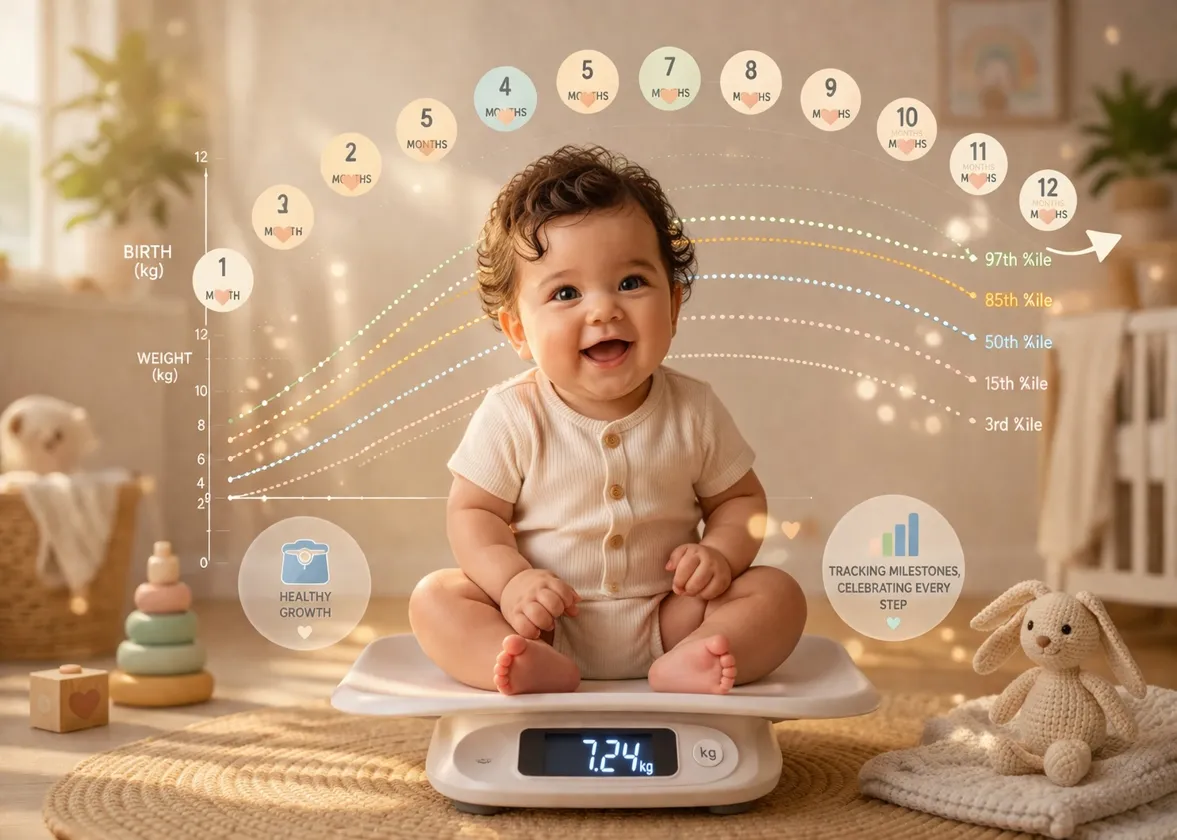
Here are the WHO 50th percentile (median) weights for boys and girls during the first year:
| Age | Boys (50th percentile) | Girls (50th percentile) |
|---|---|---|
| Birth | 7.3 lb (3.3 kg) | 7.1 lb (3.2 kg) |
| 1 month | 9.7 lb (4.4 kg) | 9.0 lb (4.1 kg) |
| 2 months | 11.5 lb (5.2 kg) | 10.6 lb (4.8 kg) |
| 3 months | 13.2 lb (6.0 kg) | 12.1 lb (5.5 kg) |
| 4 months | 14.6 lb (6.6 kg) | 13.4 lb (6.1 kg) |
| 5 months | 15.9 lb (7.2 kg) | 14.6 lb (6.6 kg) |
| 6 months | 17.0 lb (7.7 kg) | 15.7 lb (7.1 kg) |
| 7 months | 17.9 lb (8.1 kg) | 16.6 lb (7.5 kg) |
| 8 months | 18.8 lb (8.5 kg) | 17.4 lb (7.9 kg) |
| 9 months | 19.6 lb (8.9 kg) | 18.1 lb (8.2 kg) |
| 10 months | 20.3 lb (9.2 kg) | 18.7 lb (8.5 kg) |
| 11 months | 20.9 lb (9.5 kg) | 19.4 lb (8.8 kg) |
| 12 months | 21.4 lb (9.7 kg) | 19.8 lb (9.0 kg) |
Healthy infants typically double their birth weight by 4–5 months and triple it by 12 months of age, according to WHO growth standards.
Remember: these are medians (50th percentile). Half of healthy babies weigh less and half weigh more. Your baby's percentile matters less than whether they follow their own curve consistently.
How Fast Should My Baby Gain Weight?
Weight gain varies by age. The general pattern is rapid early growth that gradually slows:
| Age Range | Expected Weight Gain |
|---|---|
| 0–3 months | 5–7 oz (150–200 g) per week |
| 3–6 months | 4–5 oz (110–140 g) per week |
| 6–12 months | 2–4 oz (55–110 g) per week |
Growth spurts can temporarily increase these rates. Common growth spurt periods include 2 weeks, 6 weeks, 3 months, and 6 months.
What If My Baby Is Smaller or Larger Than Average?
Being above or below the 50th percentile is completely normal. What matters is the pattern over time, not any single measurement.
Don't worry if:
- Your baby has always been at the 15th or 85th percentile — they're following their curve
- There's a small fluctuation between visits — daily hydration and feeding affect weight
- Your baby is smaller but meeting all developmental milestones
Talk to your pediatrician if:
- Your baby crosses two or more percentile lines in either direction
- Weight falls below the 3rd percentile or above the 97th
- There's a sudden plateau in weight gain lasting more than 2–3 weeks
- Your baby is not regaining birth weight by 2 weeks of age
The AAP recommends that babies who haven't regained their birth weight by 2 weeks of age be evaluated for feeding difficulties, with assessment of intake, output, and weight gain.
Do Boys and Girls Grow Differently?
Yes. Boys tend to be slightly heavier and longer than girls at every age during the first year. This is why the WHO publishes separate growth curves for each sex.
The differences are small — typically 0.5–1.5 lb (0.2–0.7 kg) at any given month — but using the wrong chart can put your baby at an inaccurate percentile.
How Can I Track My Baby's Weight at Home?
You don't need to weigh your baby daily — weekly or biweekly is enough between pediatric visits. Babylitics makes it easy to see the big picture:
- Log weight measurements in pounds or kilograms
- See your baby's weight plotted on WHO growth curves with percentile bands
- Track growth velocity — how fast your baby is gaining over time
- Compare boys' and girls' data against the correct gender-specific WHO charts
- Share growth charts with your pediatrician via a secure link or QR code
One measurement is a data point. A series of measurements on a growth curve tells a story — and that story is what your pediatrician cares about.
Frequently Asked Questions
Track your baby's weight and see it on WHO growth curves — free for 15 days, no credit card required.