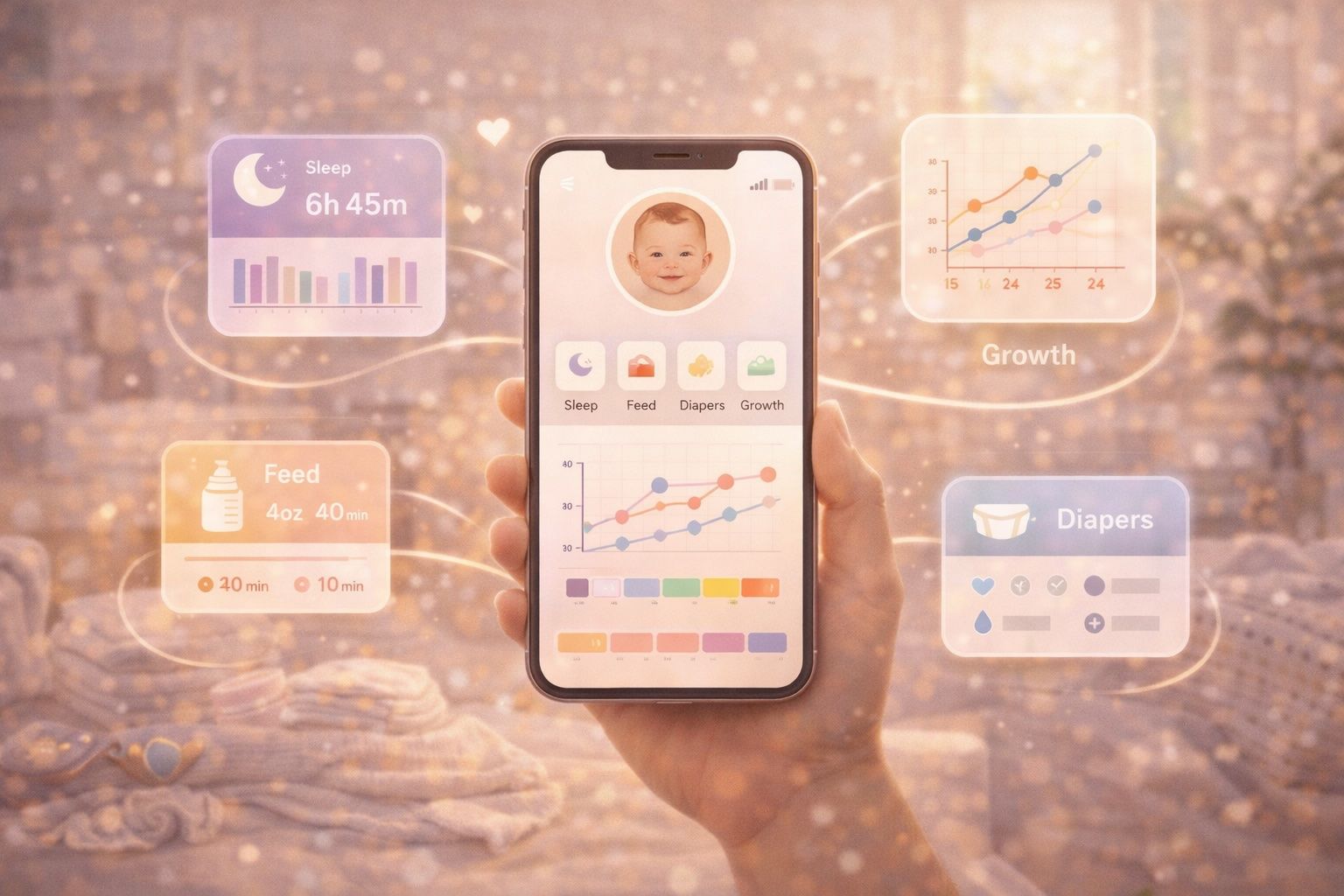

Best Baby Tracking Apps in 2026: What to Look For

On this page
With dozens of baby tracking apps available, choosing the right one can feel like another decision on an already overwhelming list. Not all trackers are created equal — some prioritize features, others privacy, and many hide costs behind subscription models. Here's what to look for and how to evaluate your options.
Why Use a Baby Tracking App?
Pediatricians recommend tracking feeding, sleep, diapers, and growth during the first year. But scribbling on paper or trying to remember details during a 2am feeding doesn't work.
The AAP recommends that parents track feeding frequency, diaper output, and weight gain during the first weeks of life to ensure adequate nutrition and hydration.
A good tracking app does three things:
- Makes logging fast — one tap, even at 3am while holding a baby
- Shows patterns — daily totals, trends over weeks, and comparisons to guidelines
- Shares data — with your partner, caregiver, or pediatrician
What Features Should a Baby Tracker Have?
Here are the core features that separate a useful tracker from a glorified notepad:
Tracking Capabilities
| Feature | Why It Matters |
|---|---|
| Feeding tracking (breast, formula, solids) | Different feeding types need different metrics — duration for breastfeeding, volume for formula, reactions for solids |
| Sleep tracking with live timer | Start/stop timers are faster than entering times manually |
| Diaper logging (wet, dirty, mixed) | One-tap logging because you're doing this 8–12 times a day |
| Weight and length | Tracking growth over time, not just single measurements |
| Temperature | Fever monitoring with age-appropriate thresholds |
Guideline Comparison
The WHO Child Growth Standards provide percentile curves for weight and length from birth to 60 months — any serious baby tracker should compare against these, not just store raw numbers.
Raw numbers without context aren't helpful. The best trackers compare your baby's data against evidence-based guidelines:
- WHO growth curves for weight and length (percentile charts)
- AAP recommendations for feeding volumes, sleep hours, fever thresholds, and diaper counts
- Age-appropriate ranges that update automatically as your baby grows
Data Sharing
Your tracking data is only as useful as your ability to share it. Look for:
- Partner access — both parents should be able to log and view data
- Pediatrician sharing — a way to show or send data to your doctor without them needing an account
- Export options — the ability to download your data (CSV, PDF) so you're never locked in
Privacy and Security
The FTC has increased enforcement of children's privacy protections under COPPA, making data security a critical factor when choosing health-related apps for families.
Baby health data is sensitive. Before choosing an app, check:
- Is data encrypted in transit and at rest?
- Does the company sell data to third parties or advertisers?
- Can you delete your data permanently?
- Where is data stored — and under what jurisdiction's privacy laws?
What About Pricing?
Baby tracker pricing models vary widely. Here's what you'll encounter:
| Model | How It Works | Watch Out For |
|---|---|---|
| Free with ads | Basic features, ad-supported | Your data may be the product |
| Freemium | Limited free tier, paid upgrades | Core features often locked behind paywall |
| Monthly subscription | $3–10/month recurring | Adds up quickly; hard to cancel |
| Annual subscription | $30–80/year | Still recurring; loses value after baby's first year |
| One-time payment | Pay once, use forever | Best value for a time-limited need |
Subscriptions can make sense for apps you use for years. But baby tracking is typically needed for 12–24 months — a one-time payment model often makes more financial sense.
How Does Babylitics Compare?
Babylitics was built with the specific problems above in mind:
| Criteria | Babylitics |
|---|---|
| Feeding tracking | Breastfeeding (duration + side), formula (volume), solids (food name + reaction) |
| Sleep tracking | Live timer, nap vs. night breakdown, AAP comparison |
| Diaper logging | One-tap wet/dirty/mixed, AAP guideline comparison |
| Growth charts | Weight and length on WHO percentile curves |
| Temperature | Readings with instant AAP fever status by age |
| Guidelines | Built-in WHO + AAP comparison on every metric |
| Sharing | Secure time-limited links + QR codes (up to 3 active per baby) |
| Privacy | No ads, no third-party data sharing, full data deletion |
| Pricing | 15-day free trial, then $24.99 for 6 months (one-time, no subscription) |
| Platform | PWA — works on iPhone, Android, and desktop without an app store |
| Multi-baby | Up to 5 baby profiles per account |
| Multi-language | English, Spanish, Dutch |
What About AI Integration?
Some modern trackers are adding AI features. Babylitics offers two ways to interact with your data through AI:
- Babylitics Custom GPT — a ready-to-use ChatGPT assistant that connects to your Babylitics data. Ask questions like "How did Emma sleep this week?" or "Log a 5oz formula feeding for Noah" through natural conversation, without any setup.
- MCP (Model Context Protocol) — for users who prefer Claude or other AI assistants, Babylitics exposes an MCP server that lets you connect your data to any compatible AI tool.
Both options are optional and require explicit authorization — your data is never shared with AI by default.
How Do I Choose the Right App?
Ask yourself these questions:
- What do I actually need to track? If you only need feeding and diapers, a simpler app may suffice. If you want growth charts with WHO curves, you need something more comprehensive.
- Does my partner need access? Multi-user support varies widely between apps.
- Am I comfortable with the privacy policy? Read it. If the app is free, understand how they make money.
- What's the total cost? Calculate the subscription cost over 12–18 months and compare to one-time options.
- Can I try before committing? A free trial lets you test the app with your actual workflow before paying.
Frequently Asked Questions
Track feedings, sleep, diapers, and growth with WHO and AAP guideline comparison — no credit card required.