

What Are WHO and AAP Baby Growth Guidelines?
On this page
- What Are the WHO Child Growth Standards?
- What Are AAP Recommendations?
- Why Do WHO and AAP Use Different Metrics?
- How Does Babylitics Use These Guidelines?
- Weight and Length vs. WHO
- Feeding vs. AAP
- Sleep vs. AAP
- Temperature and Diapers
- What Should I Do if My Baby Is Outside the Guidelines?
- How Do I Get Started?
- Frequently Asked Questions
If you've ever left a pediatric checkup wondering whether your baby's weight or length is "normal," you're not alone. The short answer: doctors rely on two trusted sources — the WHO Child Growth Standards and the AAP (American Academy of Pediatrics) recommendations — to assess how your baby is developing. Here's what they mean, why they matter, and how Babylitics helps you use them at home.
What Are the WHO Child Growth Standards?
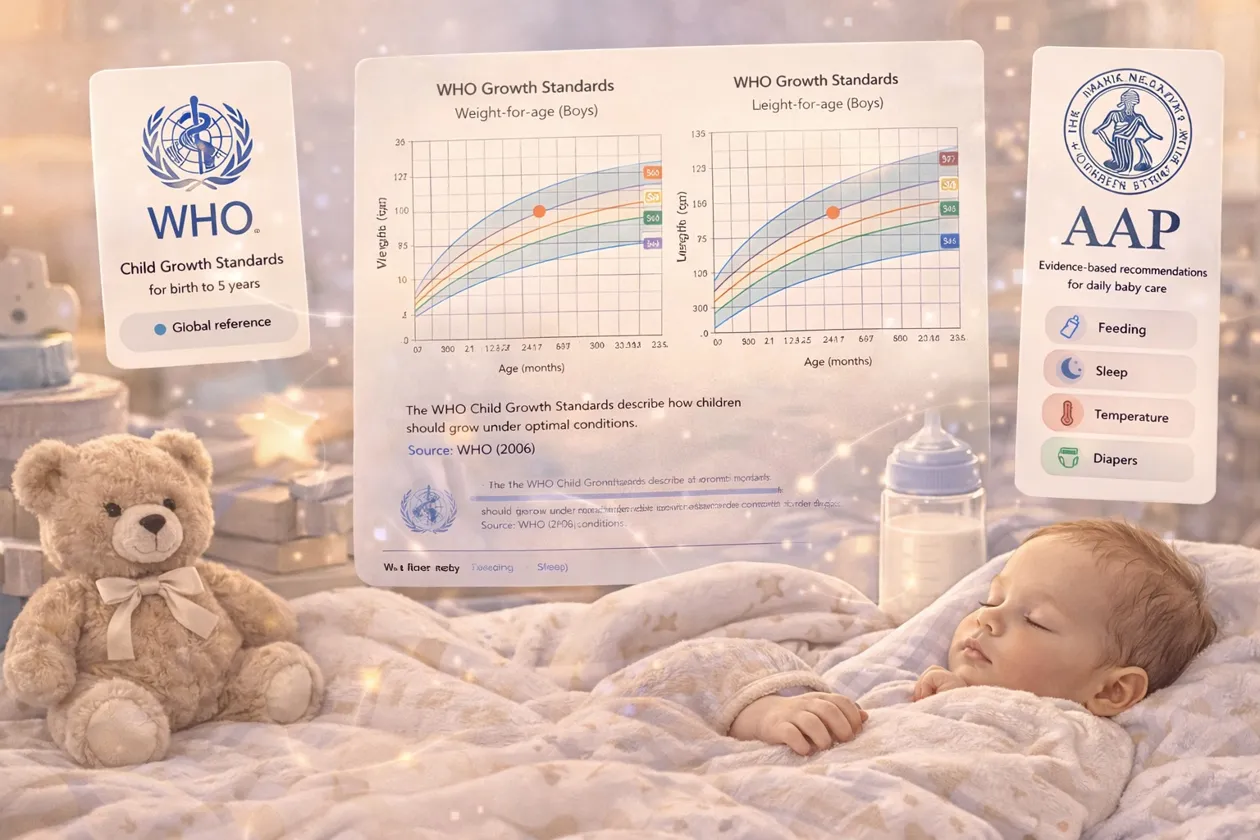
The World Health Organization published its Child Growth Standards in 2006 after studying over 8,000 healthy, breastfed children across six countries. Unlike older charts that simply described how children happened to grow, the WHO standards describe how children should grow under optimal conditions.
The WHO Multicentre Growth Reference Study followed 8,440 children from birth to age 5 across Brazil, Ghana, India, Norway, Oman, and the United States.
These standards produce the familiar percentile curves your pediatrician uses. When your doctor says your baby is at the "40th percentile for weight," it means 40% of healthy babies of the same age and sex weigh less, and 60% weigh more.
The WHO standards cover two key metrics:
| Metric | What It Measures | Age Range |
|---|---|---|
| Weight-for-age | Body weight compared to age and sex | Birth to 60 months |
| Length-for-age | Recumbent length (or standing height) compared to age and sex | Birth to 60 months |
The key takeaway: being at the 20th or 80th percentile isn't good or bad. What matters is whether your baby follows their own curve consistently over time.
What Are AAP Recommendations?
While the WHO provides growth curves for weight and length, the American Academy of Pediatrics publishes evidence-based recommendations for day-to-day care — how much your baby should eat, sleep, and what's considered a normal temperature.
The AAP recommends that infants aged 4 to 12 months sleep 12 to 16 hours per 24-hour period, including naps.
AAP guidelines cover a broader range of daily care metrics:
| Category | What It Covers | Example |
|---|---|---|
| Feeding | Volume and frequency by age | Newborns: 8–12 feedings per day |
| Sleep | Total hours and nap structure | 4–6 months: 12–16 hours total |
| Temperature | Fever thresholds by age | Newborns: above 38.0°C (100.4°F) requires attention |
| Diapers | Expected wet and dirty diapers per day | 0–3 months: 6–8+ wet diapers daily |
These aren't one-size-fits-all rules. They're ranges based on large studies, designed to give parents and doctors a shared reference point.
Why Do WHO and AAP Use Different Metrics?
This is a common source of confusion. The answer is simple: they serve different purposes.
WHO standards are built for measuring physical growth — weight and length over months. They answer the question: "Is my baby growing at a healthy rate compared to a global population of well-nourished children?"
AAP recommendations focus on daily care — feeding volumes, sleep hours, fever thresholds. They answer the question: "Is what my baby is doing today within the expected range for their age?"
The AAP recommends exclusively breastfeeding for the first 6 months, with continued breastfeeding alongside solid foods for at least the first year.
Together, they paint a complete picture. WHO tells you if growth is on track over weeks and months. AAP tells you if daily routines are within healthy bounds.
How Does Babylitics Use These Guidelines?
Babylitics doesn't just store your data — it compares everything to the relevant guidelines automatically. Every time you log a feeding, weigh your baby, or record a sleep session, Babylitics shows you where your baby stands.
Weight and Length vs. WHO
When you log a weight or length measurement, Babylitics plots it directly on the WHO percentile curves. You'll see:
- Your baby's actual measurement as a data point
- The WHO percentile bands (from the 3rd to the 97th percentile)
- The median line (50th percentile)
- Whether your baby is tracking consistently along their curve
This is exactly what your pediatrician looks at — but available on your phone anytime.
Feeding vs. AAP
Babylitics tracks both formula and breastfeeding, then compares your baby's daily intake to AAP recommendations for their age:
- Formula: total volume per day (oz or ml) compared to the AAP range
- Breastfeeding: total duration per day (minutes) compared to the AAP range
- A clear indicator showing if your baby is below, within, or above the recommended range
Sleep vs. AAP
Every sleep session — naps and night sleep — is tracked and compared to AAP sleep recommendations:
- Total sleep hours per day vs. the recommended range for your baby's age
- Breakdown of nap time vs. night sleep
- A status indicator: below, within, or above guidelines
- A sleep schedule tool that generates an ideal daily routine based on your baby's age, including wake windows, nap times, and bedtime
Temperature and Diapers
Even routine metrics are guideline-aware:
- Temperature readings are flagged against AAP fever thresholds — you'll see at a glance whether a reading is normal, low-grade fever, or requires attention
- Diaper changes are compared to expected counts by age, helping you spot potential dehydration or feeding issues early
What Should I Do if My Baby Is Outside the Guidelines?
First: don't panic. Guidelines describe ranges, not rules. A healthy baby can be at the 10th percentile for weight and be perfectly fine — as long as they're growing consistently along their own curve.
Watch for these signals instead:
- Crossing percentile lines — a sudden jump up or drop in the growth curve
- Consistently below minimums — especially for feeding volume or diaper counts
- Fever above thresholds — always contact your pediatrician for newborns under 3 months with any fever
Babylitics helps you spot these patterns early because you can see the trend over days and weeks, not just a single snapshot at the doctor's office.
How Do I Get Started?
Babylitics comes with all WHO and AAP guidelines built in. There's nothing to configure — just log your data and the comparisons happen automatically.
- Create an account and add your baby's details (birth date and sex matter for accurate guidelines)
- Start logging feedings, sleep, weight, length, temperature, or diapers
- Check the Guidelines tab in your dashboard to see all comparisons in one place
Every chart, every statistic, and every status indicator is based on real WHO and AAP data — so you always know where your baby stands.
Frequently Asked Questions
Try Babylitics free for 15 days and see how your baby compares to WHO and AAP guidelines — no credit card required.